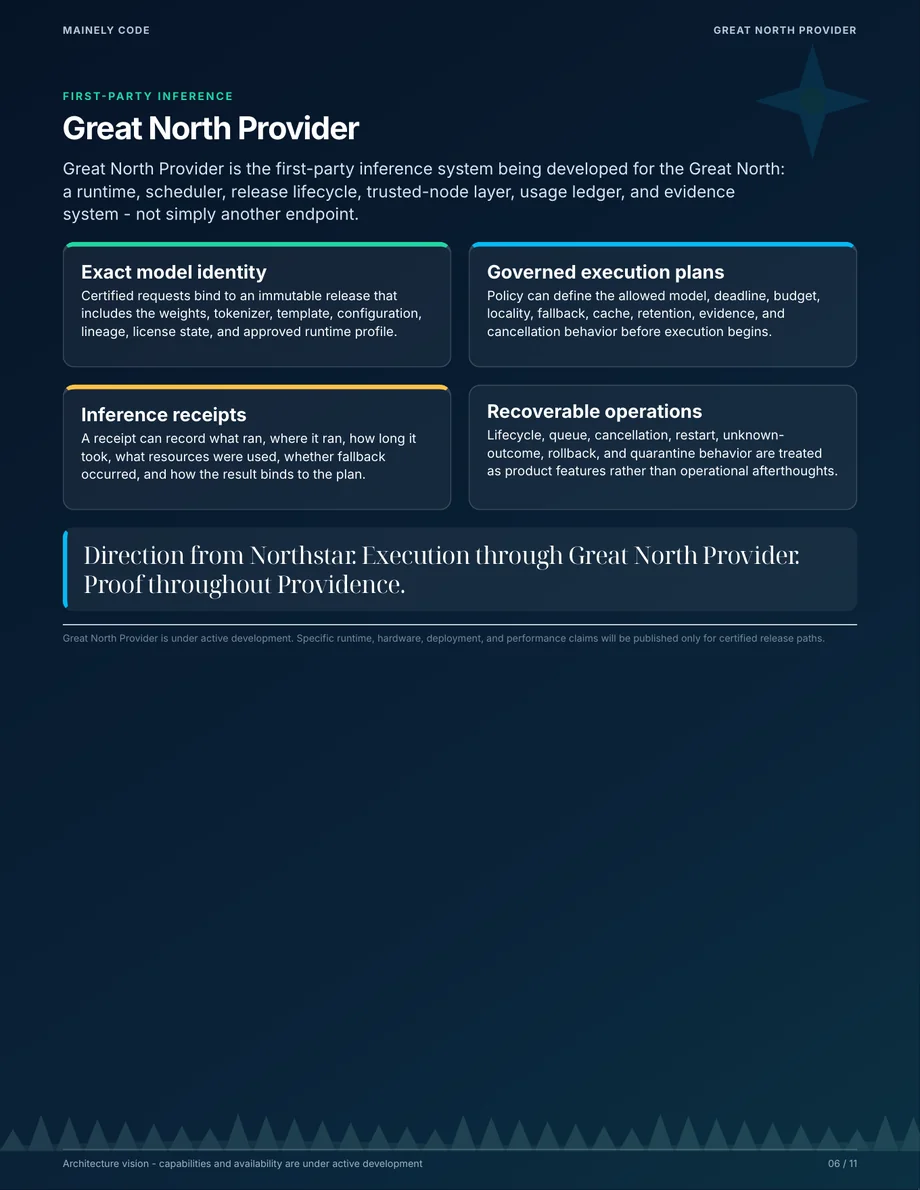
Direction from Northstar. Execution through Provider. Proof throughout Providence.
Great North Provider is being built as a Mainely-owned inference platform—not an Ollama wrapper, a vLLM skin, or a compatibility proxy. It is intended to own model execution, scheduling, lifecycle, trusted placement, usage truth, recovery, and evidence end to end.
Active development: specific runtime, hardware, deployment, and performance claims will be published only for certified release paths.
The ownership line
Provider owns execution—not cognition, policy, trust, access, or product acceptance.
Great North Provider owns
Immutable model-release identity and lifecycle
Admission, scheduling, batching, cache, and runtime execution
Streaming, cancellation, usage, cost, and resource evidence
Local and distributed Provider nodes
Recovery, quarantine, rollout, drain, and rollback
Mainely-native and compatible API surfaces
Provider does not own
Northstar's cognitive judgment or executive route
Prefrontal policy or tool governance
Network Fabric identity or effective network state
Licensing, subscription, or entitlement authority
Buildroom engineering acceptance or merge authority
Orb-Weaver design acceptance or Sasquatch customer journey
Defining contracts
Exact release. Governed plan. Verifiable receipt.
These contracts give Great North Provider an identity beyond a model-server endpoint.
ModelReleaseCapsule.v1
The deployable unit
Weights, tokenizer, template, and configuration
Approved runtimes, quantization, adapters, and hardware profiles
Lineage, license state, evaluations, limitations, and rollback target
InferencePlan.v1
The governed execution contract
Exact release or approved capability target
Budget, deadline, locality, fallback, cache, retention, and evidence
Structured-output and unknown-outcome behavior
InferenceReceipt.v1
The evidence of what ran
Plan and request digests
Model, runtime, node, timing, usage, cache, fallback, and retry evidence
Bindings back to the consuming product's verification record
Native runtime direction
No required external provider daemon.
External runtimes can remain optional adapters, rollback paths, and benchmark competitors. The certified path must be able to install, import an approved release, execute, stream, cancel, recover, prove, and unload with Ollama, vLLM, and llama-server absent.
Runtime
Mainely model loading and memory planning
Direct lifecycle ownership, resource reservation, hardware profiling, load, warm, infer, drain, unload, and verified release.
The acceptance standard is not that a model returned text. The output must survive the consuming product's real verification contract.
1
Admit
Prefrontal compiles a signed plan.
2
Execute
Provider selects the exact capsule and eligible node.
3
Receipt
The inference path produces evidence.
4
Verify
Buildroom tests the candidate in its real work order.
5
Learn
Verified outcomes improve bounded routing and release decisions.
Measured superiority
Better must be named, controlled, and proven.
Benchmark claims should use the same model, weights, quantization, prompt template, context, sampling parameters, hardware, and concurrency profile. Certification should publish time to first token, throughput, memory use, cancellation, recovery, sustained stability, identity rate, false-success count, and cost per verified outcome.
No release note should say faster, safer, or better without the benchmark and proof artifact that supports the claim.
The larger system
Provider is powerful because Providence keeps it bounded.
See how Great North Provider connects to Northstar, Prefrontal, Network Fabric, Project Sasquatch, Buildroom, Orb-Weaver, and the Licensing Server.