The Great North
The products, authorities, runtimes, trusted nodes, and handoffs that make up Mainely Code’s connected technology family.
The Great North is the ecosystem. It connects Mainely Code products, cognitive systems, execution services, trusted compute, and proof—without pretending they are one application or giving one component every kind of authority.
THE BIGGER PICTURE
Independent tools, explicit responsibilities, and a shared ambition: useful AI within reach.
The products, authorities, runtimes, trusted nodes, and handoffs that make up Mainely Code’s connected technology family.
The authority model that defines who may direct, who may permit, who may execute, where work may run, and which product may accept the result.
See Providence →Decomposition. Multi-model coordination. Evidence at every handoff. Northstar is the flagship cognitive platform at the heart of The Great North.
Original application footage · illustrative activity
Original Northstar chat background · not live AI activity. Controls set website atmosphere.
Every product has a specific customer job. Shared Mainely Code DNA does not erase those boundaries.
The flagship cognitive platform: decomposition, multi-model coordination, routing, provenance, budgets, and executive arbitration.
Active developmentExplore Northstar →
The cloud customer experience for Northstar: broad conversations, planning, synthesis, files, routing, accounts, limits, and operator-visible activity.
Public beta · Live site is source of truthExplore Sasquatch →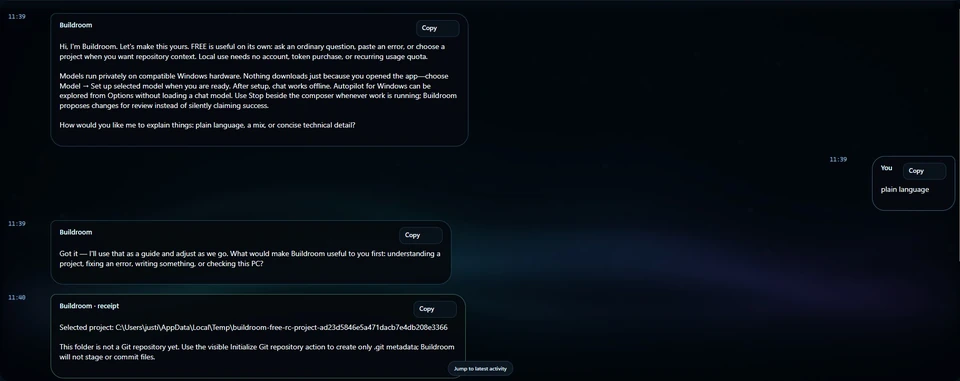
The local-first proof-driven software engineer: reviewed changes, verification, receipts, recovery, and governed delivery.
FREE + LITE on Microsoft Store · ADVANCED in developmentExplore Buildroom →
Local-first visual design intake, reviewable maps and flows, design tokens, previews, and editable interface foundations.
Microsoft Store · See current listingExplore Orb-Weaver →
An evidence-backed growth workspace in development for audience research, campaigns, leads, follow-up, and measurable next actions.
Active developmentExplore Growthroom →
The first-party inference direction for exact model execution, lifecycle, scheduling, recovery, resource truth, and inference receipts.
Active developmentExplore Provider →
A local-first workbench direction for dataset preparation, fine-tuning, evaluation, quantization, packaging, and model-development evidence.
In developmentExplore FORGE →
Human-centered security hardening, evidence, validation, remediation, and an authorized adversarial counterpart through DJINN-SRAOSHA.
Long-horizon developmentVisit SRAOSHA ↗Product direction and current public status are release-specific. A place in the ecosystem is not a claim that every product or cross-product integration is generally available.
Northstar may direct. Prefrontal may permit. Provider may execute. Network Fabric may establish where work can run. The Licensing authority establishes who has access. The consuming product decides whether the customer outcome is accepted.