Build for a purpose.
Explore models tailored to a toolchain, workflow, domain, or application rather than treating every problem as a general chat task.
A native Windows, local-first AI model-development workbench for preparing datasets, fine-tuning supported models, evaluating the actual outputs, quantizing and packaging deployment variants, and exploring new AI technologies.
For developers, independent researchers, and small technical teams.
Your ideas. Your experiments. A workbench intended to put your own computing power to work.
FROM IDEA TO EVIDENCE
A visual study of structure, iteration, and evidence.
More ways to work with AI.
A place to work on AI itself.
A particular toolchain. A focused task. A new model component. FORGE’s ambition is to bring the whole experiment into view—not leave you with a checkpoint and a question mark.
Explore models tailored to a toolchain, workflow, domain, or application rather than treating every problem as a general chat task.
Investigate custom components, training approaches, and new architectures in a workspace that leaves room for code-level experimentation.
Carry data, configuration, findings, and artifacts forward so an experiment can become a practical next step—not a forgotten checkpoint.
The proposed scope covers the model-development lifecycle. Guided workflows would be a starting point, not a ceiling on technical control.
Organize datasets, inspect examples, document sources and permissions, and separate training material from evaluation data before a run begins.
Clear inputs. Traceable preparation.Explore supported model configurations and components, understand what an experiment changes, and preserve the original model as a reference.
Visible changes. Preserved baselines.Adapt supported models to focused tasks through methods such as adapter training and fine-tuning. Deeper training paths are part of the longer-term direction.
Focused tasks. Explicit training choices.Bring model definitions, training code, and evaluation ideas into a research workflow—including new architectures and training from scratch at a feasible scale.
Code-level access. Room for original work.Compare candidates against a baseline, inspect improvements and regressions, and retain unsuccessful experiments as part of the research record.
Evidence of change. Honest outcomes.Package supported checkpoints or adapters with configuration, lineage, and evaluation findings, with the goal of making them usable outside FORGE.
Portable artifacts. Documented limitations.These are areas of planned product direction, not a released feature list. Specific models, methods, formats, and workflows will be defined and validated during development.
Approachable defaults. Deep technical access. Space for work no preset can anticipate.
Choose a supported starting model, prepare appropriate data, establish a baseline, and run a controlled specialization experiment. The aim is to make the next decision understandable: what to train, what to measure, and what the outcome means.
Explore custom components, training objectives, evaluation approaches, and architectures through a code-accessible research environment. The ambition extends beyond tuning existing models to investigating genuinely new AI technologies.
Illustrative project directions—not completed FORGE projects or guaranteed launch support.
A complete journey is the goal—not just a button that starts training and leaves you to make sense of the output.
Describe the task, hypothesis, intended use, and evidence that would demonstrate a useful result.
Choose a starting model or custom definition, review the data, and check the workload against available hardware.
Evaluate the starting point. Preserve comparison conditions and hold back appropriate test data.
Run the training or modification and retain configuration, environment, progress, and checkpoint information.
Inspect what improved, what regressed, what remains uncertain, and how resource demands changed.
Export a supported artifact with findings and limitations, then check it loads in the intended compatible runtime.
“Training finished” should never be mistaken for “the model improved.”
The planned record connects the model revision, data snapshot, configuration, environment, checkpoints, evaluations, and exported artifact. A failed hypothesis should remain useful evidence.
Conceptual workflow. Exact execution, recovery, and export behavior will be established during development.
FORGE is being engineered with the same Mainely Code software-engineering platform we ask other builders to trust.
Buildroom—ADVANCED helps us inspect, implement, test, repair, and qualify FORGE as a real native Windows product. That does not make FORGE a Buildroom edition or a Buildroom dependency. It is dogfooding with a purpose: our engineering platform helps build our model-development platform, and the evidence from that work feeds both products forward.
Explore Buildroom—ADVANCED →High-end developer PCs and GPU workstations are the initial audience. FORGE’s direction is to help builders make deliberate use of their hardware—with clear limits, not blanket compatibility promises.
Local-first by intent: prepare data, run compatible experiments, and keep project artifacts on user-controlled hardware. Setup requirements, network behavior, and data-handling policies will be defined before release.
Supported operating systems, GPU families, memory requirements, model sizes, multi-GPU configurations, and remote execution options have not yet been announced.
Planned readiness behavior—not a published hardware requirement or a performance guarantee.
FORGE is not only intended as a tool we sell. Over time, it is also planned to become the workbench we use to develop, specialize, evaluate, quantize, and package Mainely Code’s own custom models.
Specialists for defined Mainely Code workloads, toolchains, and product needs—rather than one model pretending to be best at everything.
Base, tuned, merged, and quantized artifacts are compared under controlled conditions. Training finishing is not the same as improvement.
Qualified outputs can be packaged for compatible runtimes and future Mainely Code product lanes without making FORGE itself the inference runtime.
This is a future product-family direction, not a claim that a proprietary Mainely Code model set is available today. Exact model architectures, sizes, licenses, release names, and deployment targets will be announced only after qualification.
The goal: train and export a supported model without requiring another Mainely Code product to use the result.
Conceptual handoff · Not a live integration
Prepare, modify, train, evaluate, and package the model-development project.
Validate the exported artifact and run inference within its supported environment.
Test the model in context and determine whether its output is fit for the task.
Exports would carry configuration, training lineage, evaluation findings, and applicable terms. Compatibility must be established for each format and runtime; export alone is not proof of a successful deployment.
Potential integrations preserve distinct jobs: FORGE develops models, Provider executes inference, Buildroom performs software-engineering work, and Northstar remains the flagship cognitive platform. Private or remote compute may extend the workbench by choice—not by silent relocation.
Explore The Great NorthTwo public documents. One clear distinction between what we are planning, what each product owns, and what still needs to be proven.
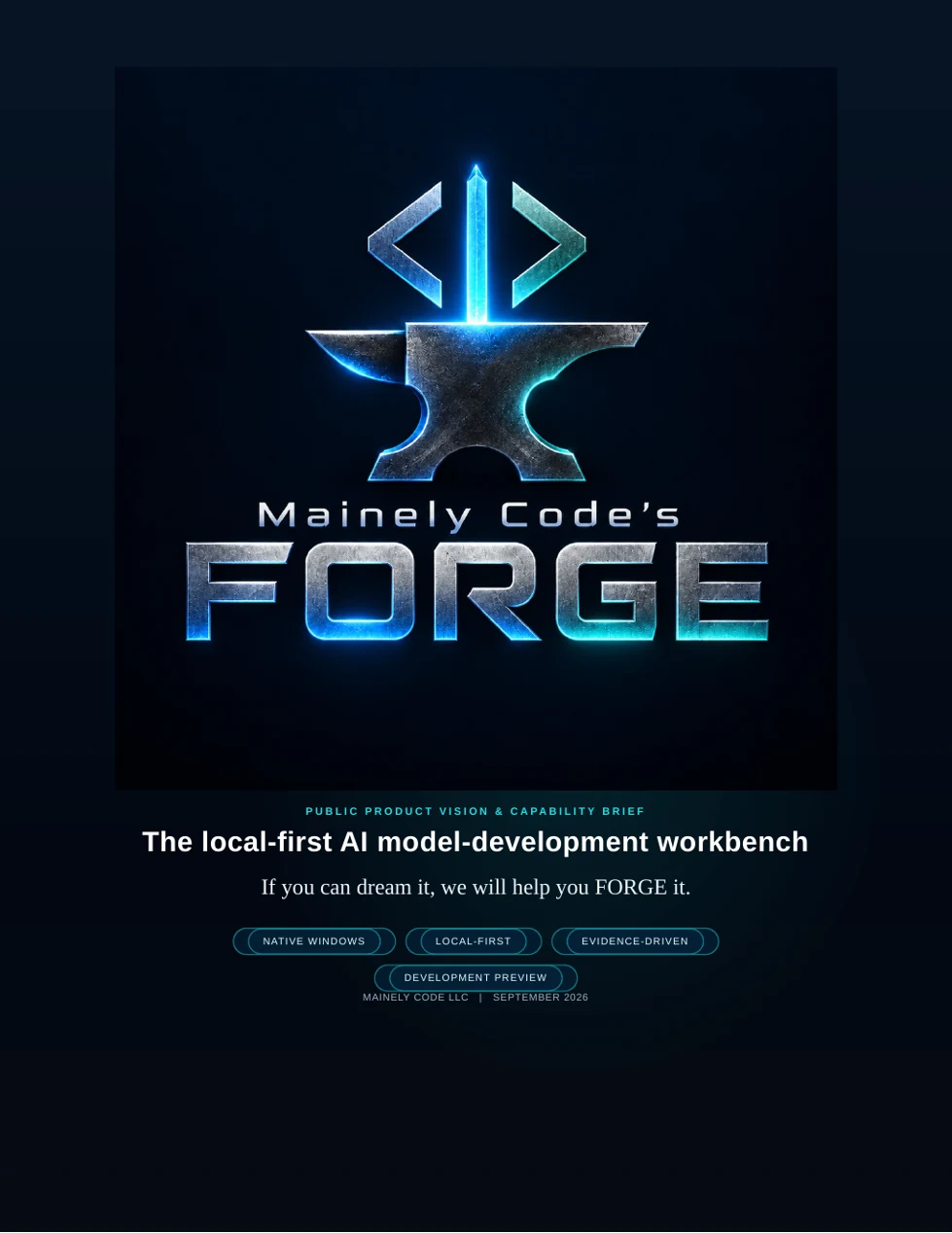
The current public capability brief: project lifecycle, datasets, LoRA/QLoRA fine-tuning, durable jobs, evaluation, quantization, packaging, evidence, privacy, security, hardware behavior, and GA standards.
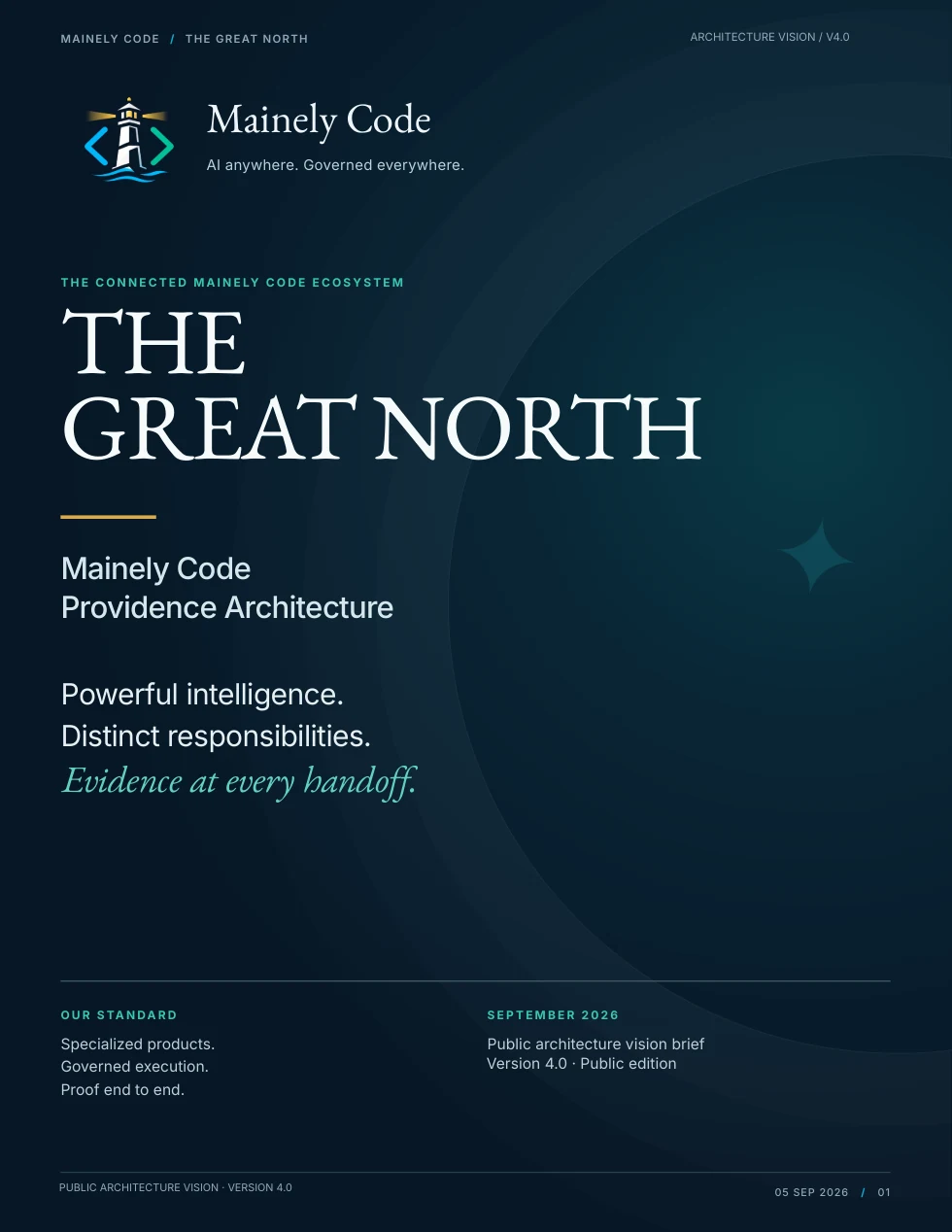
The wider product family, Northstar, Provider, authority boundaries, deployment direction, and FORGE’s place in the ecosystem.
FORGE’s product vision is the source for this page. The architecture brief places it within the wider ecosystem without making Provider or another Mainely Code product a prerequisite.
Browse publications & PDFsFollow Mainely Code as FORGE moves from concept into development. Have a model-development workflow, research problem, or hardware constraint worth understanding? Tell us about it.
Product direction as of . Scope and delivery plans may change as development and validation proceed.
FORGE is a native Windows, local-first AI model-development workbench in active development. Its planned GA direction brings dataset preparation, model intake, fine-tuning, durable experiment execution, evaluation, quantization, packaging, export, and open-ended AI research into one traceable workspace.
Not yet. FORGE is in active development and is not being presented as a released application. Release timing, distribution, pricing, licensing, and qualified hardware/model profiles will be announced after the required workflows are implemented and proven.
The initial audience is developers, independent researchers, and small technical teams with high-end PCs or GPU workstations who want to develop specialist models and explore AI technologies on user-controlled hardware.
The proposed scope includes specialization through methods such as adapter training and fine-tuning, alongside code-level experiments and training from scratch at a feasible scale. Exact methods, supported models, and launch workflows will be defined and validated during development.
Those requirements have not been announced. Compatibility will be described for tested combinations of model, training configuration, hardware, drivers, and runtime. The high-end workstation audience is not a minimum specification or a promise that every powerful PC will be supported.
No such dependency is intended. FORGE is planned as a standalone product, with the goal of exporting supported models for use in compatible runtimes without requiring another Mainely Code product. Any future Provider integration would be optional and separately validated.
Local-first is the intended direction: prepare data, run compatible experiments, and keep project artifacts on user-controlled hardware. Optional private or remote compute may follow over time. Setup, network behavior, data-handling policies, and supported execution paths will be defined before release.
Buildroom helps developers build software with AI. FORGE is intended to help developers build the AI itself. They have different jobs, workflows, and outputs; FORGE is not another Buildroom edition.
Yes. FORGE is proudly being built with Mainely Code Buildroom—ADVANCED. We are using our own proof-driven software-engineering platform to help implement and qualify FORGE. FORGE remains a separate standalone product and will not require Buildroom to use.
That is part of the long-term direction. Mainely Code plans to use FORGE to develop, specialize, evaluate, quantize, and package a custom Mainely Code model set. No specific proprietary model release is being announced yet; models will be named and published only after they pass qualification.
“Make state-of-the-art AI accessible, usable, and approachable for Everyone.”
FORGE extends that mission from helping People use AI to helping them shape it. A workbench for specialist models. A place to test original ideas. A clearer path from experimentation to something useful.