
Skip to content
LIVE NOWBuildroom—FREE EDITION 1.8.5 includes 3B · 4B · 7B · 8B. Same price: $0.
Mainely CodeAI anywhere. Governed everywhere.
The governed architecture behind The Great North

Providence.Capability is not permission.

Providence defines who may direct, who may permit, who may execute, where work may run, and who may accept the result. It keeps powerful systems connected without allowing authority to blur at the handoffs.

Governed plansExact executionEvidence at every handoff
Approved Providence architecture star tower artwork
Northstar directsGoals, decomposition, routes, budgets, provenance
Prefrontal permitsModels, tools, locality, fallback, evidence, stop rules
Provider executesExact release, lifecycle, scheduling, recovery, receipt
The product acceptsCustomer outcome, verification, rollback, terminal truth

The Great North is the ecosystem. Providence is the governed architecture that prevents any one component from quietly becoming planner, policy authority, runtime, access authority, and judge.

Authority by design

Each system has a right to act—and a line it cannot cross.

Confidence, availability, or raw capability never grants broader authority on its own.

N

Northstar directs.

Owns goals, decomposition, specialist arbitration, route recommendations, executive budgets, and provenance. It does not own runtime lifecycle, entitlement, node truth, or product acceptance.

Prefrontal permits.

Compiles the allowed model or expert, locality, fallback graph, tools, memory, budgets, verification policy, and stop conditions. Cognitive confidence is not permission.

Pr

Provider executes.

Owns exact release execution, load/warm/drain/unload lifecycle, scheduling, usage truth, recovery, and the inference receipt. It cannot weaken policy or declare product success.

NF

Network Fabric establishes where.

Owns trusted node identity, reachability, hardware eligibility, leases, and network evidence. Reachable does not automatically mean trusted or permitted.

L

Licensing establishes who.

Owns identity, subscription, product-specific entitlement, signed access, assignment, and revocation. One product’s access must not silently unlock another.

The consuming product accepts.

Buildroom, Orb-Weaver, Growthroom, Sasquatch, or another product owns its customer job and acceptance contract. An execution receipt is evidence—not automatic success.

The governed path

Power moves through explicit handoffs.

Every transition preserves the requested outcome, scope, permissions, execution identity, evidence, and safe next action.

01Customer intentThe product owns the job.
02Northstar routePlans and coordinates cognition.
03Prefrontal planCompiles policy and limits.
04Trusted placementFabric proves eligible compute.
05Provider executionRuns the exact approved release.
06Product proofThe customer outcome is verified.

No silent relocation. No silent fallback. No execution receipt masquerading as customer acceptance. If the model, endpoint, scope, budget, locality, tool, or evidence contract changes, Providence requires that change to be visible and governed.

Deployment posture

Place the work deliberately.

Providence can govern local machines, private or LAN capacity, hosted paths, and customer-owned environments. Location changes the operating conditions; it does not change which authority owns the decision.

Local / edge

Qualified customer-controlled hardware, local data, and release-specific resource limits.

Private fabric

Trusted office, lab, MSP, or customer compute with signed identity, eligibility, leases, and proof return.

Hosted paths

Regional, dedicated, or customer-owned options designed around isolation, residency, audit, and policy.
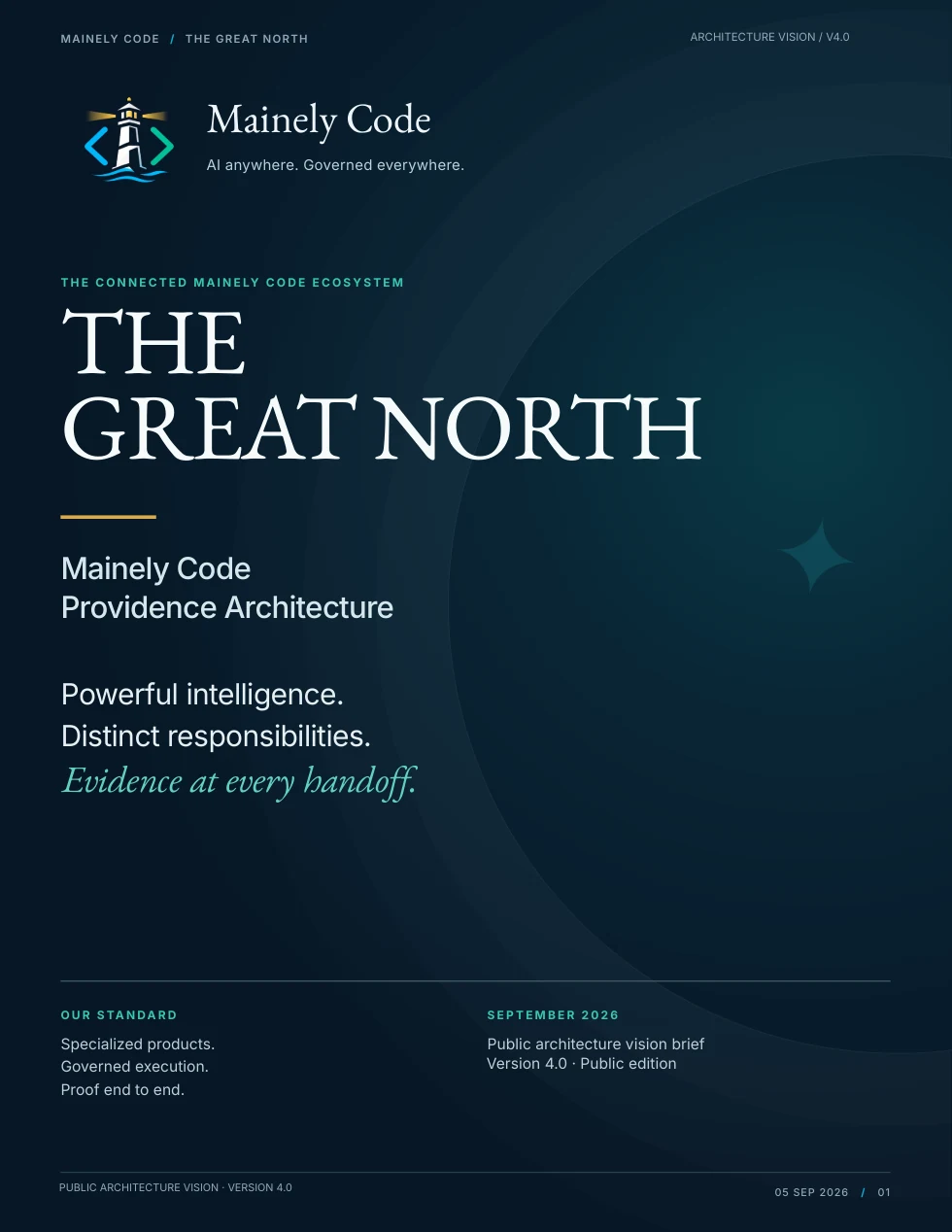
Cover of The Great North public Providence architecture vision brief
Public architecture vision

Read the Providence brief.

The current public document describes The Great North ecosystem, authority boundaries, deployment direction, Northstar, Provider, and product acceptance.